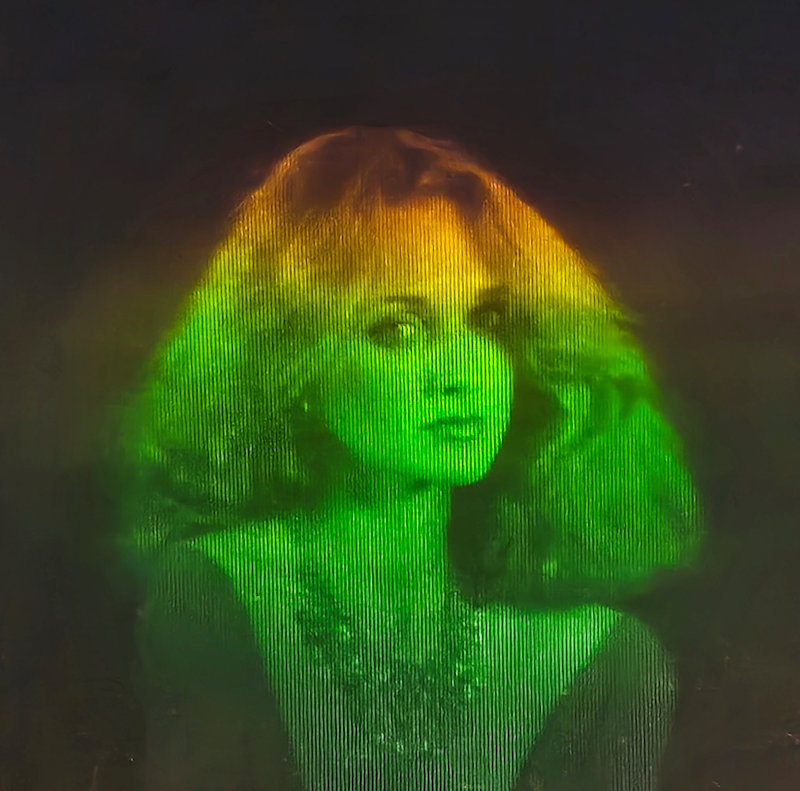
Between the 1970s and the 1990s, I made a large number of integral holograms in 100-degree, 120-degree, and 360-degree format on holographic film and on 4x5 and 8x10 holographic glass plates. These were made on apparatuses of my design and implementation. Truly an intersection of art and technology, my holographic art practice could not have been realized without my technical background and ability to design and implement complex opto-mechanical systems.
My integral holograms were made of sequential frames of motion picture film imaged on an optical table through a large cylindrical lens onto the holographic recording plane.The filmed images were recorded with a Mitchell 35mm motion picture camera while the subject was on a rotating platform.
A 360-degree integral hologram of a complete rotation of the subject can comprise about 2000 individual holograms. Ideally each of these individual cylindrical holograms need to be of equal modulation (brightness). Since the holographic recording process can take over 6 hours, this is in practice extremely difficult to realize.
Not apparent in the photographs below, the virtual images of the subjects float about 8" behind the holograms. The holograms can be rotated, translated, or presented flat. For holograms of less than 130-degrees they can be displayed flat without translation with minimal, non-apparent distortion.
When displayed in a flat format, the holograms can be displayed like most 2-dimension art with the addition of a suitably placed cylindical light source immedialy behind the hologram.
Below are a few selected examples of my integral holography. My body of integral holographic work comprises over 80 integral holograms.
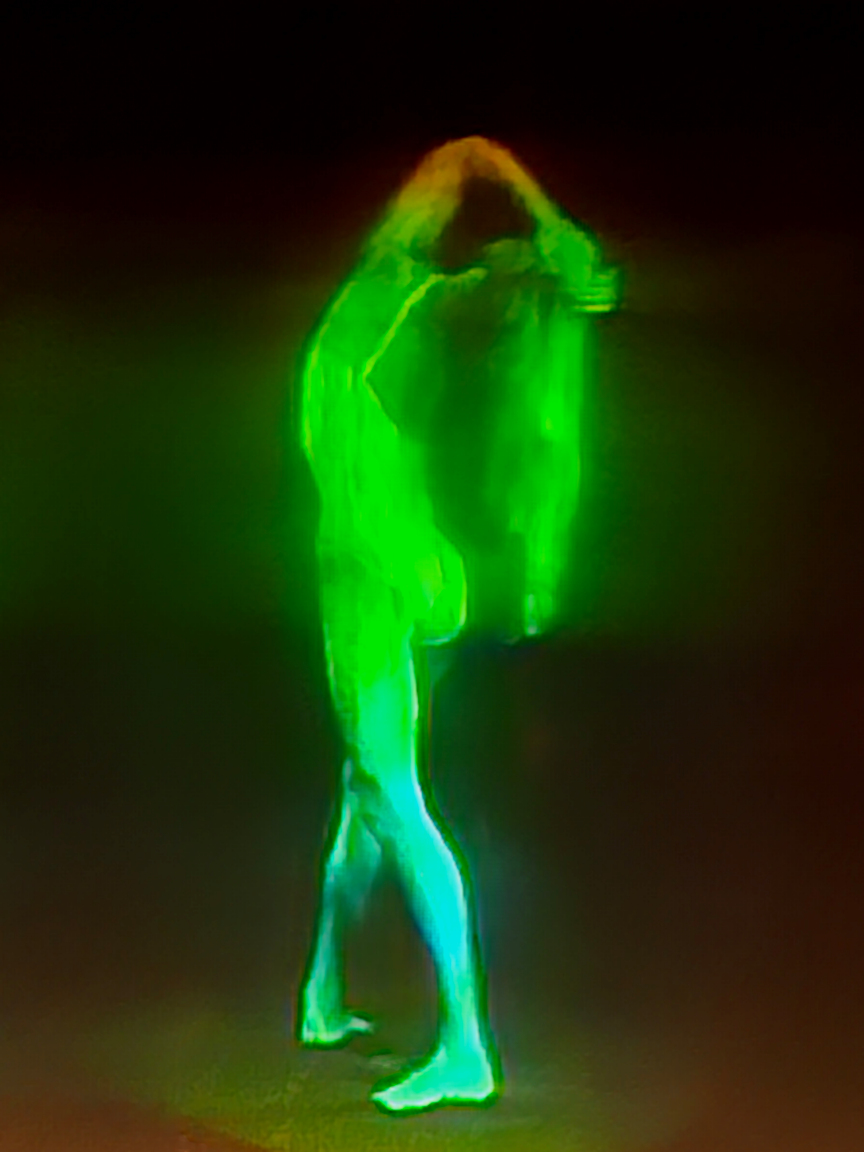
Integral hologram, choreographed by Gary Fisher, holography by Gary Fisher.
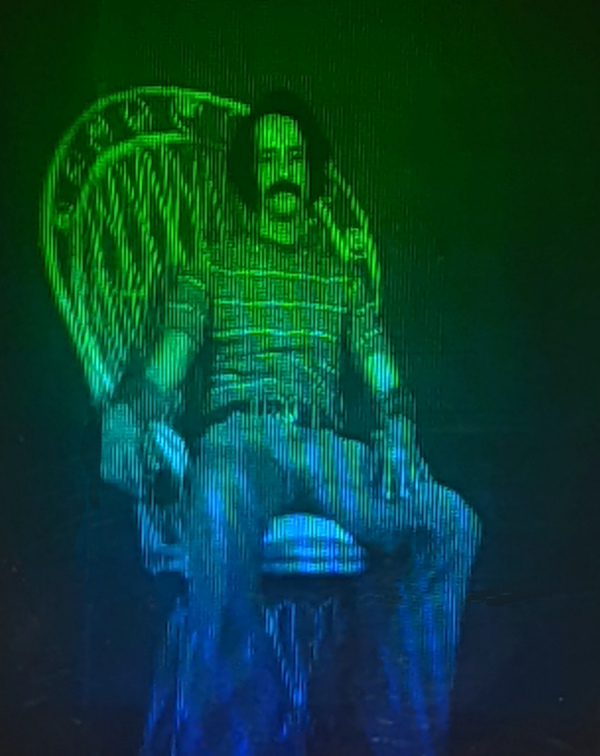
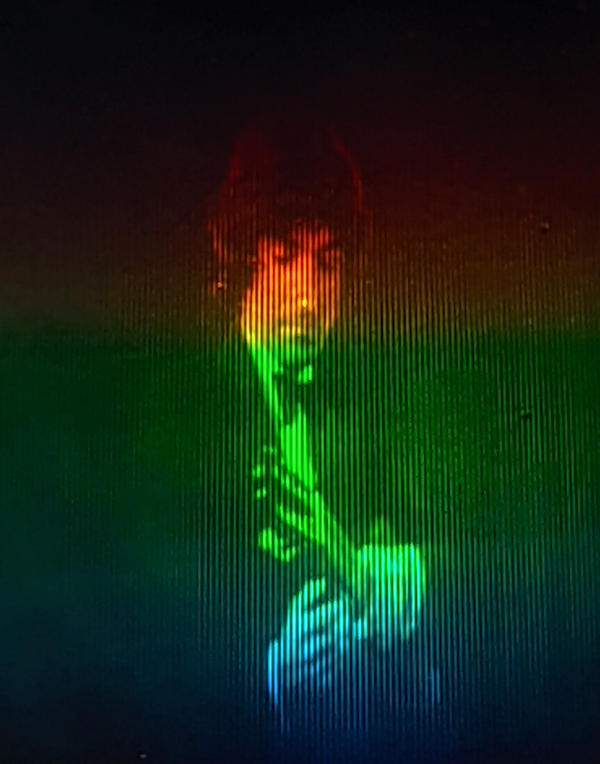
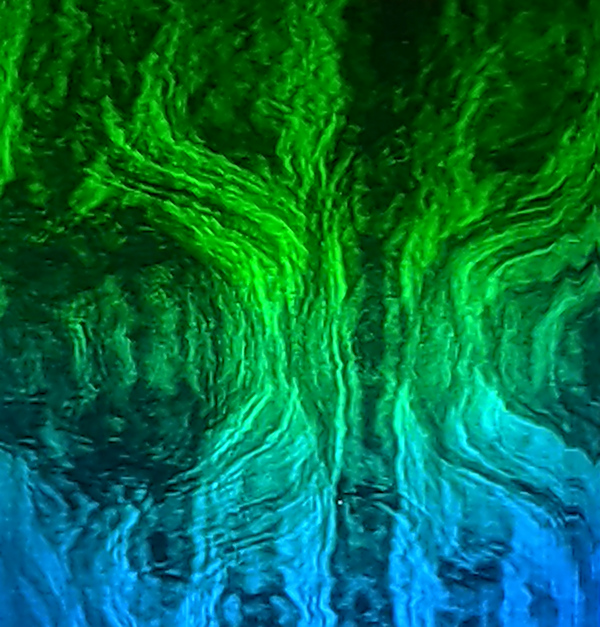
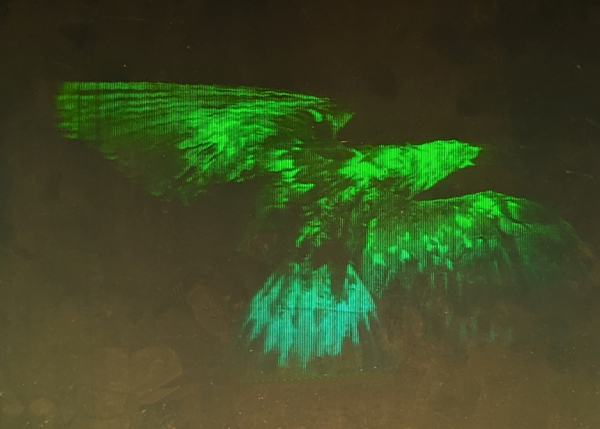
In May 2026 The Los Angeles County Museum of Art (LACMA) acquired this hologram as part of their permanent collection.
Also shown during this exhibition was a laser transmission hologram, and a light-beam projection.